Learn why a judge dismissed indictments against the former FBI director and the New York attorney general, President Trump's unusual role in these cases, and what might happen next.
Updated 12/09/2025
Why Trust Us?
Fact-Checked
Nolo was born in 1971 as a publisher of self-help legal books. Guided by the motto “law for all,” our attorney authors and editors have been explaining the law to everyday people ever since. Learn more about our history and our editorial standards.
Each article that we publish has been written or reviewed by one of our editors, who together have over 100 years of experience practicing law. We strive to keep our information current as laws change. Learn more about our editorial standards.
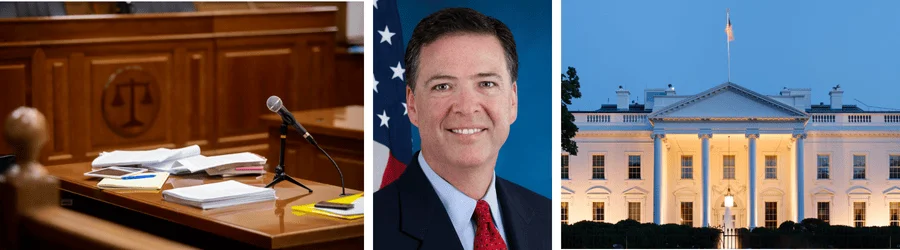
On November 24, 2025, a federal judge dismissed the criminal case against former FBI Director James Comey, ruling that the United States attorney who obtained the indictment had been unlawfully appointed. The same day, the judge dismissed the case against New York Attorney General Letitia James for the same reason. Comey and James have argued that they are being prosecuted because President Trump views them as enemies, not because they broke the law. Their cases raise important questions about presidential power, the independence of federal prosecutors, and politicization of the criminal justice system.
In this article we'll summarize the charges against Comey and James, and explain why they're arguing that the cases against them aren't legitimate. We'll also look at some of the unusual political and procedural issues that have complicated these criminal cases, and discuss what might happen next now that a judge has dismissed the indictments. We'll continue to update this article as these cases unfold.
What Are the Charges Against James Comey?
Comey was the director of the Federal Bureau of Investigation (FBI) from 2013 until he was fired by President Trump in 2017. While he was head of the FBI, Comey oversaw the government's investigation of possible Russian interference in the 2016 presidential election.
The charges against Comey, which were filed in September 2025, relate to his testimony in a September 2020 Senate hearing. Comey was asked about previous testimony in which he'd denied ever leaking information (or authorizing anyone else at the FBI to leak information) about the Russia investigation or the Hillary Clinton email investigation. In his testimony in September 2020, Comey stood by his previous statements. The government asserts that this testimony was false, and an attempt to obstruct a congressional investigation. Comey and his attorneys argue that he was telling the truth, and that the government's case relies on misinterpreting his answers to ambiguous questions.
Is Comey a Victim of Vindictive or Selective Prosecution?
Comey and his lawyers say that his prosecution is retaliation for his role in the Russia investigation, and for his criticism of President Trump after leaving the FBI. In legal terms, Comey's argument is that he's a victim of vindictive or selective prosecution. These concepts are related, but not identical:
- Vindictive prosecution is when a person is targeted because they exercised a legal right.
- Selective prosecution is when a person is targeted for an impermissible reason—for example, because of their race, religion, or political activities.
Comey's argument is that he's being targeted because he's exercised his First Amendment right to criticize the president. In most cases it's very difficult for a defendant to successfully argue that they're a victim of vindictive or selective prosecution. A defendant must convince the court that prosecutors brought the case for illegal or impermissible reasons, and that the prosecution's legal arguments are a cover for their real motives. Courts are extremely reluctant to second-guess prosecutors' motives in specific cases, or to question their discretion to prosecute certain crimes (or defendants) and not others.
However, Comey may have a stronger argument than most defendants who argue that they're being prosecuted unfairly. Similar arguments can be made by Letitia James, the New York attorney general. James filed a civil suit against Trump in 2022 and a criminal case against him in 2023. James was indicted in October 2025, on one count of bank fraud and one count of making a false statement to a financial institution.
Both Comey and James argue that their prosecutions are an extension of President Trump's personal animosity and political interests, rather than the product of evenhanded criminal investigations. Comey's lawyers, for example, have pointed out that Trump would ignore Comey until Comey publicly criticized him, at which point Trump would respond by, among other things, calling for Comey to be jailed. And Trump's public comments about James include a social media post where he said, "IF YOU GO AFTER ME, I'M COMING AFTER YOU!" Statements like these give Comey and James more evidence than most defendants can muster that their prosecutions are driven by impermissible ulterior motives.
The Unusual Origins of the Comey and Letitia James Indictments
The Comey and James prosecutions are also unusual because of how they originated and who brought the charges. These circumstances have been cited by Comey and James as evidence that they are being prosecuted unfairly.
James' Criminal Referral for Mortgage Fraud
James' indictment for mortgage fraud originated with a criminal referral by Bill Pulte, the head of the Federal Housing Finance Agency (FHFA). Pulte, who was appointed to his position by President Trump, has also referred Senator Adam Schiff, Congressman Eric Swalwell, and Federal Reserve Governor Lisa Cook for prosecution. This is unusual because criminal referrals are usually made by FHFA investigators, not by someone appointed by the president. Schiff and Swalwell are both Democratic critics of President Trump. Cook's referral came after months of complaints by the president about Federal Reserve decisions not to lower interest rates.
Career Prosecutors' Refusal to Indict Comey and James
Decisions about who to prosecute are normally made by career prosecutors, who have experience evaluating criminal investigations and are not directly appointed by the president. Prosecutors in the James case prepared a memo stating they did not believe the case could be proven beyond a reasonable doubt, the standard for a criminal conviction. And prosecutors in the Comey case wrote that there was not probable cause to indict Comey—meaning they did not believe it was more likely than not that he had broken the law.
Erik Siebert, the interim United States Attorney for the Eastern District of Virginia, relayed these concerns to the Department of Justice. As the judge who dismissed the Comey and James cases noted, these concerns apparently resulted in Siebert's resignation on September 19, 2025. President Trump told reporters "I want him out," and after the resignation he claimed that he had fired Siebert.
President Trump then sent a message to the Attorney General, Pam Bondi, recommending Lindsay Halligan—who had worked as one of Trump's personal lawyers and then as a White House staffer—to replace Siebert. He also told Bondi, "They impeached me twice, and indicted me (5 times!), OVER NOTHING. JUSTICE MUST BE SERVED, NOW!!!" On September 22, Bondi appointed Halligan as the new interim US Attorney for the Eastern District of Virginia.
Halligan's Indictments of Comey and James
The statute of limitations deadline for the allegations against Comey was five years. This meant that, if he was not charged by September 30, 2025, he could never be charged for alleged crimes stemming from his Senate testimony in 2020. This deadline pressure may be one reason Halligan—who had no experience as a prosecutor—was the sole lawyer who presented the Comey case to a grand jury. The grand jury returned a two-count indictment against Comey on September 25. (There are questions about the validity of the grand jury process, which we'll discuss below.) Halligan's signature was the only one on the indictment.
James was indicted on October 9, 2025. As the judge who dismissed the Comey and James cases noted, Halligan was the only attorney who presented the James case to the grand jury, and her signature was the only one on the indictment. Halligan also fired the prosecutor who wrote the memo questioning whether the charges against James could be proven beyond a reasonable doubt.
Why Did a Judge Dismiss the Cases Against Comey and James?
Both Comey and James filed several motions to dismiss their indictments, making several different legal arguments. On November 24, 2025, Judge Cameron McGowan Currie decided that both cases should be dismissed because Lindsay Halligan's appointment as an interim United States attorney was not valid.
The basis for this ruling is Title 28, Section 546 of the United States Code. Under this federal law, the attorney general has limited authority to appoint interim United States attorneys. An interim appointee chosen by the attorney general can only serve for 120 days. After that 120-day period, any future United States attorney must either be:
- a permanent United States attorney appointed by the president and confirmed by the United States Senate, or
- another interim United States attorney appointed by the federal district court.
(28 U.S.C § 546 (2025).)
This rule prevents presidents from continuing to appoint "interim" US attorneys as a way of avoiding the Senate confirmation process. Instead, the appointment power eventually transfers to the district court.
This law, Judge Currie ruled, rendered Halligan's appointment invalid. Halligan's predecessor, Erik Siebert, was an interim United States attorney who'd been appointed by the attorney general in January 2025. He was reappointed by the federal district court in May 2025. Siebert had served as interim United States attorney for much longer than than 120 days when he resigned in September 2025. Therefore, his replacement had to be either a full US attorney confirmed by the Senate, or a new interim appointee named by the district court.
In other words, as Judge Currie noted in her opinions dismissing the cases, Halligan "was not an 'attorney authorized by law' to conduct grand jury proceedings" when she secured the indictments against Comey and James. The attorney general attempted to fix this problem by retroactively naming Halligan a "Special Attorney." But Judge Currie rejected this approach because "[i]t would mean the Government could send any private citizen off the street—attorney or not—into the grand jury room to secure an indictment so long as the Attorney General gives her approval after the fact. That cannot be the law."
What Happened in the Comey Grand Jury?
At the federal level and in many states, the government can only prosecute someone if that person has been indicted by a grand jury. In theory this process prevents prosecutions that are based on flimsy evidence. In practice, however, grand juries tend to be very friendly to prosecutors. That's because prosecutors present all the evidence, and grand jury witnesses aren't allowed to have their attorneys present. Because the grand jury process is largely managed by prosecutors, courts tend to defer to prosecutors when evaluating their conduct before a grand jury.
The Federal Rules of Criminal Procedure also place strict limits on when and how evidence presented to a grand jury (including transcripts of witness testimony) can be shared by anyone not directly involved with the proceedings of that grand jury. (Fed. R. Crim. P. 6 (2025).)
However, according to a federal magistrate judge, "government misconduct may have tainted the grand jury proceedings" in the Comey case. Because of this possible misconduct, the judge took the highly unusual step of ordering the government to turn over all of the transcripts and other grand jury materials to Comey's attorneys. The magistrate identified several significant problems with how the case was presented to the grand jury.
As we noted above, a different judge has dismissed the Comey and James cases on other grounds. But, if that dismissal is overturned on appeal, Comey can argue that his case should be dismissed again because of these grand jury issues.
Problems With the Comey Search Warrants
In 2019 and 2020, the government obtained warrants to search a hard drive, an iCloud account, an iPad, and an iPhone owned by Daniel Richman, Comey's friend and attorney. Halligan's presentation to the Comey grand jury relied heavily on information obtained through these searches. The magistrate noted several significant problems with the government's use of that information against Comey.
Attorney-client-privilege. Since Richman is a lawyer, the government was obligated to make sure that its searches respected attorney-client privilege. But the government did not notify Comey, who was one of Richman's clients, of the searches. Comey therefore never had an opportunity to review the material that was turned over to the government, and never had the chance to assert attorney-client privilege over any of it. An FBI agent on the case warned the agent leading the investigation that some of the material they'd reviewed might be privileged. The lead agent nevertheless testified in front of the grand jury (and was the only grand jury witness).
The Fourth Amendment. Under the Fourth Amendment, when the government obtains a search warrant it is only authorized to search for and seize the specific items specified in that warrant. The Richman search warrants weren't part of the Comey investigation, and sought evidence of completely different crimes. The government nevertheless kept all of the electronic documents it seized from Richman, without trying to separate material not covered by the search warrant.
This approach alarmed the magistrate, who wrote that "[t]his cavalier attitude towards a basic tenet of the Fourth Amendment and multiple court orders left the government unchecked to rummage through all of the information seized from Mr. Richman, and apparently, in the government's eyes, to do so again anytime they chose." The magistrate also noted that it was "highly unusual" that the government did not seek a new search warrant when it began investigating Comey for different crimes than the ones covered by the original Richman search warrants.
On November 26, 2025, Richman filed a motion in federal court that made many of the same arguments. The motion asks a judge to order the government to delete the files it copied from Richman's devices. On December 6, 2025, the judge granted Richman a temporary restraining order, prohibiting the government from using the files while the court considers his request. If the court grants Richman's motion it could further complicate any effort by the government to restart its case against Comey.
"Fundamental Misstatements of the Law"
The magistrate reviewed the grand jury transcripts and noted two examples of Halligan making "fundamental misstatements of the law that could compromise the integrity of the grand jury process." Importantly, the prosecutor presenting evidence to the grand jury is also the grand jury's legal advisor. Since there's no judge in the grand jury room, it's up to the prosecutor to accurately explain the law to grand jurors.
Halligan's exact statements are redacted from the magistrate's opinion, since the grand jury material is still secret. However, the magistrate's discussion of the statements sheds some light on what Halligan may have said.
The Fifth Amendment. The magistrate wrote that one of Halligan's statements "suggest[ed] to the grand jury that Mr. Comey does not have a Fifth Amendment right not to testify at trial." Halligan was responding to questions from grand jurors about the evidence against Comey. Based on the context, the magistrate wrote, Halligan seemed to be telling the grand jurors that, "if she could not satisfactorily answer their questions, then Mr. Comey would ‘[REDACTED]' answer these questions at trial." In other words, the magistrate wrote, Halligan suggested that Comey might be obligated to "explain away the government's evidence" at the trial.
Sufficiency of the grand jury evidence. Grand jurors are only supposed to consider the evidence presented to them by the prosecutor. They cannot use assumptions about other evidence as a reason to indict someone. And the prosecutor cannot imply that the government has additional evidence of the defendant's guilt that it isn't presenting to the grand jury. However, the magistrate concluded that one of Halligan's statements suggested to the grand jurors that they "did not have to rely only on the record before them to determine probable cause but could be assured the government had more evidence–perhaps better evidence–that would be presented at trial."
Questions About the Grand Jury Record and Final Indictment
An indictment can't be returned by a grand jury unless the full grand jury has voted on it. However, it's not clear that this happened in the Comey case. The grand jury was asked to consider three criminal counts against Comey. It rejected one of them, but voted to indict him on the remaining two counts. This required Halligan to draft a second document, so that the grand jury could approve the final two-count indictment.
However, there is no evidence in the grand jury recordings or transcripts that this final vote ever happened. Instead, Halligan may have simply spoken with the grand jury foreperson and ignored the requirement of a final vote by the full grand jury. As the magistrate wrote, "[i]If this procedure did not take place, then the Court is in uncharted legal territory in that the indictment returned in open court was not the same charging document presented to and deliberated upon by the grand jury."
The alternative, the magistrate noted, is that a final vote did happen, but was not captured by the grand jury recordings or transcripts. Whatever actually happened, the magistrate decided that the situation "calls into question the presumption of regularity generally associated with grand jury proceedings," and gave Comey's attorneys grounds to challenge the indictment.
When Will Comey's Lawyers Get the Grand Jury Materials?
The magistrate's ruling won't immediately result in Comey's attorneys receiving the grand jury materials. The government is appealing the decision, and the materials will only be turned over if the magistrate's decision is confirmed by an appellate court. In addition, since a judge has dismissed the case against Comey on other grounds, it's possible that his attorneys won't need the grand jury materials, and will therefore never get to review them. The dismissal would have to be overturned on appeal for these grand jury irregularities to become relevant again.
What Happens Next?
The Trump Administration has said it will appeal the dismissal of the cases against Comey and James. If an appeal is successful then the cases will proceed, and James and Comey will have to pursue their other arguments for why their indictments should be dismissed. If the appeal fails, then the dismissals will stand.
Meanwhile though, for now nothing prevents the government from going back and trying to get new indictments against Comey and James. The judge dismissed their cases "without prejudice," which normally means charges can be refiled. And the Fifth Amendment's prohibition against double jeopardy only applies once a criminal trial has begun (either with a jury being empaneled, or a judge swearing in a witness). Since grand jury proceedings don't trigger double jeopardy, prosecutors who have failed to secure an indictment (or had a case thrown out before trial) can ask another grand jury to indict the defendant for the same crime.
However, there may be obstacles to reviving the prosecutions. For example, it's unclear if the cases against Comey and James are strong enough to make new indictments likely. On December 4, 2025, a grand jury refused to indict James on the same charges that were dismissed by the judge in late November. Future attempts to indict James or Comey may not fare any better.
Moreoever, a new prosecution of Comey may be barred by the statute of limitations. The government is arguing that the statute of limitations was paused when Comey was indicted, and that it has additional time to seek a new indictment. That's normally true. But Comey's case was dismissed because the judge decided that Halligan was not legally authorized to ask a grand jury for an indictment. So, Comey's attorneys will argue that the statute of limitations clock was never stopped by an indictment, because there never was a valid indictment.
We'll be updating this article to reflect important legal developments in these cases.
Copyright ©2025 MH Sub I, LLC dba Nolo ® Self-help services may not be permitted in all states. The information provided on this site is not legal advice, does not constitute a lawyer referral service, and no attorney-client or confidential relationship is or will be formed by use of the site. The attorney listings on this site are paid attorney advertising. In some states, the information on this website may be considered a lawyer referral service. Please reference the Terms of Use and the Supplemental Terms for specific information related to your state. Your use of this website constitutes acceptance of the Terms of Use, Supplemental Terms, Privacy Policy, Cookie Policy, and Consumer Health Data Notice.
Your Privacy Choices