When you go to court for your traffic ticket, you'll likely have a trial with a judge.
Updated 11/18/2025
Why Trust Us?
Fact-Checked
Nolo was born in 1971 as a publisher of self-help legal books. Guided by the motto “law for all,” our attorney authors and editors have been explaining the law to everyday people ever since. Learn more about our history and our editorial standards.
Each article that we publish has been written or reviewed by one of our editors, who together have over 100 years of experience practicing law. We strive to keep our information current as laws change. Learn more about our editorial standards.
In most of the 50 states, you don't have the right to a jury trial in a traffic ticket case, which means a judge alone decides whether or not you are guilty. In the others, you can insist on a jury trial.
When only a judge is present, traffic violation trials tend to be fairly informal—certainly more so than the trials for serious crimes portrayed in movies or on TV. Informality is particularly likely when the only witness for the state is the police officer and no prosecutor is present. (This is common in many states.) Here, we provide you with an overview of what is likely to happen with and without a prosecutor.
Understanding the Courtroom
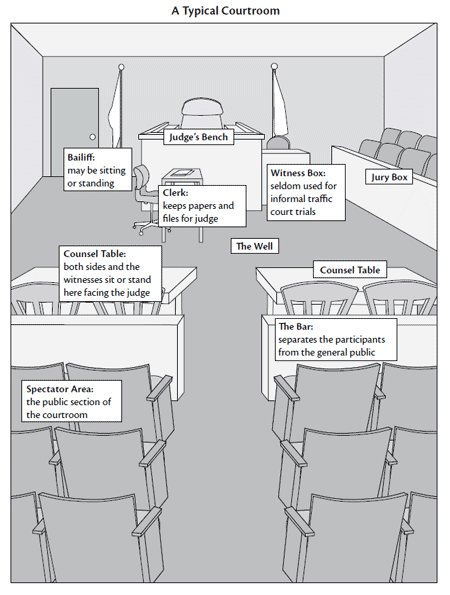
Traffic court trials are generally conducted in courtrooms that look much like those on television. In addition to the judge, a clerk and a bailiff will normally be present. The clerk sits at a table immediately in front of the judge's elevated bench, or slightly off to the side. The clerk's job is to keep the judge supplied with necessary files and papers and to make sure that proceedings flow smoothly. Depending on the state, there might also be a court reporter present, who keeps a word-by-word record of proceedings.
Get to court early for your trial. Most courts have security—and that can take a while if it's a busy day. In larger court houses, it can take a few minutes to find the right courtroom, which in some states is called a "department." Once you arrive, tell the court clerk or bailiff you are present, then take a seat in the spectator section.
Courtrooms are divided about two-thirds of the way toward the front by a sort of wooden fence known as "the bar." The judge, court personnel, lawyers, and you (after your case is called) use the area in front of the bar. The public, including you and other people waiting for their cases to be heard, is seated in the main body of the room. When the judge or clerk reads (calls) the name of your case, you may cross through the bar into the area where the judge sits. When you come forward, you sit at one of two long tables, known as the counsel tables, facing the judge.
In courtrooms that follow an informal approach, your witnesses should accompany you to the counsel table. At more formal trials, they remain behind the bar (as does the police officer) and testify at the witness stand only when their names are called. If you watch a few cases before yours, you'll quickly see how things are being handled. In some courtrooms, you and any witnesses will be asked to raise your right hand and swear to tell the truth before the judge arrives. In a few, you or your witnesses will be sworn in only just before testifying.
Informal Procedures in Some States
An increasing number of states (including Florida, Massachusetts, Michigan, Rhode Island, Oregon, and Washington) have completely "decriminalized" minor traffic offenses. In most cases, this means that the procedures for fighting traffic tickets are much less formal than in states where traffic cases are decided in criminal court. Though this might sound reassuring, unfortunately, it also means that, along with formality, you lose some of the important rights and procedures guaranteed in criminal court.
Some of the differences you might encounter in states with a civil traffic system include:
- A lower burden of proof. The standard the government must meet is often—but not always—lowered to the preponderance or clear and convincing standard, which makes it harder for the person fighting the ticket.
- Some of the rules of evidence (for example, the hearsay rule) or rules of criminal procedure (for example, rules permitting discovery of the officer's notes before trial) might not apply. Again, the suspension of these rules makes it harder to win your case.
- Some states, including Florida and Rhode Island, have set up administrative agencies completely separate from the courts for hearing traffic violations, so you never see a courtroom or a real judge, just a hearing officer. In some cases (for example, Washington, DC), even your first appeal is heard within the administrative agency.
- In some jurisdictions, you may be able to have a virtual hearing for a traffic ticket over video conferencing.
In some of the states with civil traffic systems, you have the choice between a formal and informal hearing. Given the choice, you should rarely opt for an informal hearing, especially if the rules in your state say that an officer doesn't have to be present at an informal hearing. By insisting on the officer's presence, you get the advantage of being able to challenge the officer's statement in court. And you also gain the very real possibility that the officer won't show up to testify against you, which means the case will most likely be dismissed.
 Be polite and respectful. Be polite to all court personnel—most especially the judge. This might be tough to do if you have a genuine beef with the legal system and feel angry or hostile. But realize that if you express your anger or hostility, the judge is very likely to hold it against you. Judges want you to be able to separate your emotions from the facts of the case. And remember: No matter how informal a courtroom, all judges, when spoken to, expect to be called "Your Honor."
Traffic Trials Without a Prosecutor
In many states, it's common for traffic court trials to be handled without the presence of an assistant district attorney or other prosecuting attorney. After the clerk calls the case, the police officer simply presents testimony as to why they think you're guilty. Then you have a chance to cross-examine before presenting your defense.
With no prosecutor present, the judge normally will allow the officer to tell their side of the story in narrative form, perhaps interrupting to ask a few questions. You should then have an opportunity to ask the officer relevant questions—called cross-examination. You should be prepared to cross-examine the officer.
 What to do if the judge tries to get you to waive cross-examination. Some judges might not tell you that you have the right to cross-examine, or recommend that you just skip this stage and present your defense. In most states, they must let you cross-examine if you insist. It is usually wise to do so, since getting the officer to appear unsure of what happened or to admit that they can't remember key facts is one important way to create a reasonable doubt as to your guilt.
After you question the officer, you get to present your side of the dispute and present the testimony of any of your witnesses. At any time during either presentation or after you are both done, the judge might ask questions. Finally, the judge will announce a verdict of guilty or not guilty. If the judge finds you guilty, they will usually pronounce the sentence (the fine) right away.
The judge is boss: Be prepared for anything. While this article outlines the usual ways a traffic case works, understand that judges have a great deal of leeway in running their own courtroom. Some judges won't listen patiently to your well-prepared and practiced presentation. Instead, they will insist on questioning you, the officer, and all witnesses. And, as noted above, a judge might even try to rebuff your attempts to cross-examine the officer, ask questions of your own witnesses, or make a final statement.
It will greatly help you understand what is expected (and modify your presentation accordingly) if you can watch a few cases in the courtroom of the judge who will hear your case. And it should also help if, in advance, you make a concise list of the points of your defense that you feel must be made during the trial. Then, if the judge derails your presentation, you can glance at your list and say something like this: "Your Honor, I have prepared a few brief points that I think are crucial to my case and would like to be allowed to present them to you." Most judges will slow down and grant you this polite request.
Trials Handled by a Prosecutor
In some courts, a prosecutor (normally a lawyer from the district, county, or city attorney's office) will present the state's case. As mentioned, this is likely to result in a more formal courtroom proceeding. In addition to each side presenting its own testimony and having a chance to cross-examine witnesses, each party may also make a formal opening and closing statement. In theory, you have the right to make an opening statement before the officer testifies, and a closing statement after all evidence is presented, but if no jury or prosecutor is present, many judges will try to save time by pressuring you to waive these procedures. To find out in advance if a prosecutor will be handling the case, you can try to ask court personnel or actually go to the courtroom where traffic cases are held and see what the standard procedure is.
Talk to a Lawyer
Need a lawyer? Start here.
How it Works
- Briefly tell us about your case
- Provide your contact information
- Choose attorneys to contact you

Get Professional Help
Talk to a Traffic Ticket attorney.
How It Works
- Briefly tell us about your case
- Provide your contact information
- Choose attorneys to contact you
Copyright ©2025 MH Sub I, LLC dba Nolo ® Self-help services may not be permitted in all states. The information provided on this site is not legal advice, does not constitute a lawyer referral service, and no attorney-client or confidential relationship is or will be formed by use of the site. The attorney listings on this site are paid attorney advertising. In some states, the information on this website may be considered a lawyer referral service. Please reference the Terms of Use and the Supplemental Terms for specific information related to your state. Your use of this website constitutes acceptance of the Terms of Use, Supplemental Terms, Privacy Policy, Cookie Policy, and Consumer Health Data Notice.
Your Privacy Choices