Learn how long it takes at each stage to appeal a disability denial, along with what you can do at each step to increase your chances of winning.
Updated 10/27/2025
Why Trust Us?
Fact-Checked
Nolo was born in 1971 as a publisher of self-help legal books. Guided by the motto “law for all,” our attorney authors and editors have been explaining the law to everyday people ever since. Learn more about our history and our editorial standards.
Each article that we publish has been written or reviewed by one of our editors, who together have over 100 years of experience practicing law. We strive to keep our information current as laws change. Learn more about our editorial standards.
If you've applied for Social Security Disability Insurance (SSDI) or Supplemental Security Income (SSI) and received a denial letter, don't get too discouraged—you can file an appeal. An appeal means that you disagree with Social Security's decision not to award you benefits and are asking the agency to come to a different conclusion. The appeals process is the same regardless of whether you're filing for SSDI or SSI.
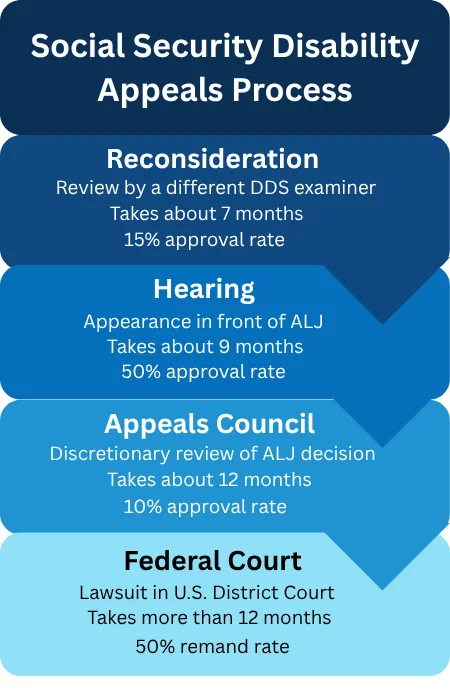
There are four levels of disability appeals—reconsideration, hearing, Appeals Council, and federal district court. At each stage, you have 60 days to submit a written appeal in order to proceed to the next level. Most disability claimants aren't approved on their first try, so odds are likely that you'll be denied at least once (and have to wait a while for the next decision). Once you have a good sense of the appeals timeline and how the process works, you'll be in a better position to get disability benefits at each step of review.
First Appeal Level: Request for Reconsideration
After the Social Security Administration (SSA) denies your initial application for disability benefits—or terminates your ongoing benefits after a continuing disability review—your first appeal is a request that the initial denial or the termination be reviewed again. This appeal level is called a "reconsideration."
Reconsideration of Your Original Disability Claim
Reconsideration is a complete review of your claim that takes place at the Disability Determination Services (DDS) level. DDS is a stage agency that helps process local claims for federal disability benefits. Although DDS issued your initial denial, reconsideration is performed by a medical consultant and claims examiner who weren't involved in the initial decision.
During reconsideration, DDS looks at all the evidence considered in your initial determination plus any new evidence—like recent medical exams or hospitalizations—that you submit or that DDS obtains. The process takes on average seven months, and only about 14% of claims are awarded following reconsideration.
Your initial denial notice will include information about your right to request a reconsideration and a paragraph about your medical condition. You have 60 days after you receive your denial notice to file a written request for reconsideration, which you can do online or by printing out Form SSA-561-U2 and mailing it to your local Social Security office.

Reconsideration of Your Continuing Disability Benefits
Beneficiaries who've already been awarded SSDI or SSI and are receiving payments will have their cases looked at periodically throughout a continuing disability review to see if they're still disabled. If, after the review, Social Security determines that your condition has improved enough that you can return to work, the agency will stop sending you monthly benefits.
You can appeal the decision to end your benefits much in the same way you appeal an initial denial. You can start the process by filing Form SSA-789, Request for Reconsideration - Disability Cessation. When you appeal, keep in mind that Social Security can't end your benefits just because your health has gotten slightly better. The agency needs to find that you have significant medical improvement to the point that you can now engage in full-time work activity.
Second Appeal Level: Administrative Law Judge (ALJ) Hearing
If you're denied again—whether for your original claim or your termination of benefits—after reconsideration, the next step is to ask for a disability hearing with an administrative law judge, or "ALJ." You can do this by submitting Form HA-501, Request for Hearing By Administrative Law Judge, to your local Social Security office or using Social Security's online tool. On average, it takes about nine months from when you request a hearing until the date your hearing is held.
Unlike disability examiners at the initial and reconsideration levels, judges don't work for state DDS offices. Instead, they work at Social Security's Office of Hearings Operations (OHO), with locations spread throughout the country. Your case will likely be assigned to a judge at an OHO that handles claims in your geographic area, although some cases may go to an ALJ at a national hearing center.
Hearings are conducted in-person, over the phone, or by videoconference. (You have the option to choose the manner of appearance that you prefer.) At your hearing, you'll have the opportunity to tell the ALJ about why you should be considered disabled. Overall, ALJs approve almost half of the claims that reach them, making the hearing level statistically your best chance of getting benefits.
Third Appeal Level: the Appeals Council
Following your disability hearing, you'll receive a written decision in the mail. If you get an unfavorable decision from the judge, you have 60 days to ask for a review of the decision by the Appeals Council. You can do this by submitting an online request or mailing Form HA-520, Request for Review of Hearing Decision/Order to Social Security's Office of Appellate Operations in Baltimore.
It can take up to one year to get a decision on your request for review, and the requests are typically denied. That's because the Appeals Council gives a lot of leeway to the ALJ as the "trier of fact" who has seen you in person, talked with you, asked you questions, and heard your answers. Because of this judicial discretion, the Appeals Council doesn't review cases unless the ALJ made a mistake that constitutes "reversible error."
Reversible errors are those that would change the outcome of your case if they hadn't been made. They can be procedural, such as not providing you enough notice before the hearing, or substantive, like ignoring important medical evidence. If the Appeals Council finds that the ALJ made a reversible error, your case will be sent back ("remanded") to the judge with instructions on what issues need to be given another look. That usually means that you'll have another hearing, giving you the opportunity to help the judge correct their mistake.
Fourth Appeal Level: Federal Court
The Appeals Council is the last stage of "administrative appeals," meaning that there are no more steps you can take within the Social Security Administration in order to get the agency to award you disability benefits. So if the Appeals Council didn't pick up your case for review and you want to appeal your claim further, you'll need to file a lawsuit in federal district court.
Federal judges hear disability cases without juries. Unlike ALJ hearings, which have relaxed evidentiary rules, district court judges use the Federal Rules of Civil Procedure to review the case for legal errors (although many judges rule on factual questions too). Although you have a decent chance of winning an appeal in federal court—especially if you're fighting a cessation of benefits—it's expensive and time-consuming, making it an unattractive option for most claimants.
Increase Your Chances of Winning a Disability Appeal With a Lawyer
While you aren't required to hire an attorney at any part of the appeal process, it's almost always a wise move—especially at the hearing level and beyond. Having a representative to avoid any pitfalls at your disability hearing is a smart way to increase your chances of winning your claim at the stage where you're best positioned to be awarded benefits. If you were denied after a hearing, a lawyer can help you decide whether you should appeal your claim or file a new application. And you'll almost certainly want to get an attorney if you want to take your case to federal court.
Still on the fence? Check out our article on when to talk to a Social Security disability lawyer. Ready to take the plunge? Learn how to find a good disability lawyer.
DIY Legal Tools from Nolo
Book & eBook
Nolo's Guide to Social Security Disability
Book & eBook
Social Security, Medicare & Government Pensions

Copyright ©2025 MH Sub I, LLC dba Nolo ® Self-help services may not be permitted in all states. The information provided on this site is not legal advice, does not constitute a lawyer referral service, and no attorney-client or confidential relationship is or will be formed by use of the site. The attorney listings on this site are paid attorney advertising. In some states, the information on this website may be considered a lawyer referral service. Please reference the Terms of Use and the Supplemental Terms for specific information related to your state. Your use of this website constitutes acceptance of the Terms of Use, Supplemental Terms, Privacy Policy, Cookie Policy, and Consumer Health Data Notice.
Your Privacy Choices